

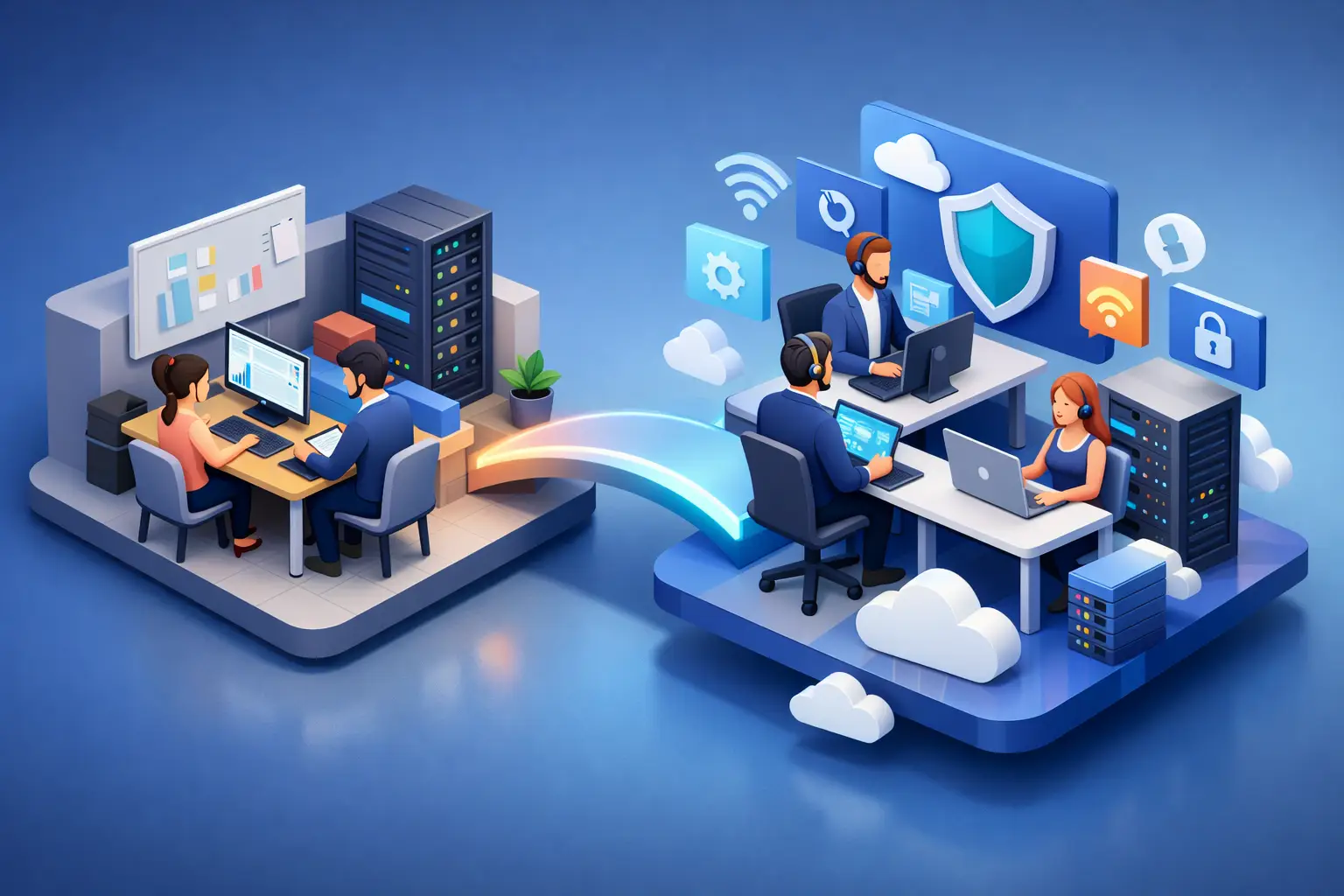
If your office loses half a day every time the Wi-Fi drops, a printer stops talking to the network, or someone clicks the wrong email, you do not have an IT problem. You have a business slowdown problem. That is exactly why an outsourced IT department for small business has become a practical move for companies that need reliable systems without building a full internal team.
Small businesses rarely struggle because technology matters too much. They struggle because it touches everything. Sales depends on email and CRM access. Operations depends on connected devices, shared files, and working workstations. Leadership depends on accurate reporting, secure systems, and vendors that actually answer the phone. When support is reactive, fragmented, or slow, the damage spreads fast.
What an outsourced IT department for small business really means
A lot of companies hear the phrase and think it means calling a help desk when something breaks. That is only part of it. A true outsourced IT department for small business functions like an ongoing operating partner, not a last-minute repair shop.
That means user support, device management, network oversight, cybersecurity, software updates, backups, vendor coordination, and long-term planning are all handled under one service structure. Instead of relying on the office manager, a freelance technician, and whoever happens to be “good with computers,” you get organized accountability.
For a small business, that matters more than having a single technical specialist on payroll. One internal person can be helpful, but they usually cannot cover strategy, help desk, security, cloud systems, compliance, infrastructure, and after-hours emergencies at the same time. Outsourcing fills those gaps with a broader bench and clearer process.
Why small businesses choose this model
The biggest reason is simple: hiring a full in-house team is expensive, and under-hiring is risky. Most small businesses do not need a CIO, systems administrator, security lead, and support technician as separate full-time roles. They do need those functions covered.
That is where outsourcing makes business sense. You get access to a team with different skill sets without carrying the full salary, benefits, training, and turnover costs of building that team yourself. You also avoid the common trap of depending on one employee who becomes the only person who understands your systems.
There is also the speed factor. Business owners and operations managers are tired of chasing multiple vendors for internet issues, device setup, cybersecurity alerts, software problems, and server questions. Consolidating support cuts delay and confusion. One accountable team means fewer handoffs and less finger-pointing.
For companies in growth mode, there is another advantage. As headcount, locations, software, and customer data expand, IT needs become more structured fast. A provider that can support infrastructure, security, and day-to-day support gives you room to scale without rebuilding your approach every six months.
What should be included in the service
Not every provider offering outsourced support is delivering a real department-level service. Some are mainly ticket-based support with light monitoring. That can work for very small environments, but it is not enough for a business that depends on uptime and data security.
A stronger model usually includes help desk support for your staff, proactive monitoring for devices and networks, patching and maintenance, user onboarding and offboarding, cybersecurity tools, backup oversight, cloud support, and IT planning. If your business has a physical office, on-site support should also be part of the conversation.
The difference between basic support and true outsourced department coverage is ownership. When a provider takes ownership, they are not just waiting for tickets. They are looking at risk, capacity, user issues, recurring problems, and upcoming needs before those issues turn into downtime.
If you deal with regulated data, remote teams, multiple locations, or industry-specific applications, that ownership becomes even more valuable. The right team helps you make better decisions about access controls, device policies, vendor management, and system changes before mistakes become expensive.
The trade-offs you should understand
Outsourcing is not magic, and it is not one-size-fits-all. For some companies, a fully internal IT team still makes sense, especially if technology is the product or if the environment is highly specialized. If you run a large internal development operation or highly customized enterprise systems, you may need in-house leadership paired with outside support.
For most small and midsized businesses, though, the trade-off is usually worth it. You give up having someone physically down the hall at all times, but you gain access to a broader team, more predictable coverage, and stronger specialization.
The key is making sure the provider can deliver both remote responsiveness and hands-on service when needed. A provider that only works from a distance may struggle with office moves, cabling problems, hardware rollouts, or infrastructure troubleshooting. On the other hand, a provider that only shows up on-site but lacks process and monitoring will leave you exposed between visits.
A balanced model works best. Fast remote support handles day-to-day issues quickly, while on-site capability covers the physical side of your environment.
Signs your current setup is costing you money
Many businesses wait too long because their IT situation feels annoying but manageable. The problem is that unmanaged inefficiency rarely stays small. It turns into lost labor hours, preventable security risk, delayed onboarding, and frustrated staff.
If employees are regularly blocked by login issues, aging equipment, unreliable internet, poor file access, or inconsistent software performance, that is not normal overhead. It is operational drag. If cybersecurity only comes up after a suspicious email or a failed backup, the business is already behind.
Another common sign is vendor sprawl. You may have one company for phones, another for cybersecurity, another for website work, another for networking, and a local technician for emergencies. Every separate relationship adds communication gaps. When nobody owns the full picture, problems last longer and decisions get harder.
That is where a more integrated service model stands out. Businesses often need more than device support. They need technology, security, infrastructure, and outward-facing systems to work together. In practice, that could mean aligning office network upgrades with VoIP performance, website uptime, access controls, and user productivity rather than treating each area as a separate project.
How to choose the right outsourced IT partner
Start with response time and scope. If a provider takes too long to connect your staff with help, little else matters. Ask how support requests are handled, what escalation looks like, and whether on-site service is available in your area.
Then look at breadth. Can they handle managed support, cybersecurity, cloud platforms, network equipment, vendor coordination, and office infrastructure? A provider with shallow coverage may still leave you managing multiple outside partners. That defeats one of the biggest advantages of outsourcing.
Communication matters just as much as technical skill. You want a team that can explain issues clearly, recommend practical next steps, and keep projects moving without making everything sound complicated. Good support should reduce noise, not add to it.
It is also smart to ask how they approach planning. Small businesses do not just need fixes. They need someone tracking equipment age, license needs, security gaps, user growth, and budget priorities. A good partner helps you plan for what is next instead of reacting to what just broke.
For businesses that want fewer vendors and stronger alignment across operations, working with a partner that can support both internal systems and business-facing services can be a major advantage. That is one reason companies turn to firms like KnowIT. They want one accountable team that can support the technical backbone while also helping the business present, market, and scale more effectively.
When outsourcing delivers the most value
The return is usually strongest when downtime is expensive, internal resources are stretched, and decision-makers are tired of piecing support together. Law offices, healthcare practices, construction firms, professional services companies, retail operations, logistics businesses, and multi-location offices often feel this first because their teams need systems to work every day without excuses.
It also delivers value during change. If you are growing, relocating, hiring quickly, adopting new software, tightening security, or preparing for compliance requirements, outside support can provide structure and execution at the same time.
The goal is not just to fix computers. It is to create a working environment where your staff can stay productive, your data stays protected, and your leadership team is not wasting time coordinating technical chaos.
A small business does not need a patchwork of vendors and temporary fixes to operate like a larger company. It needs dependable systems, fast support, and a partner that can keep up. When the right team is in place, technology stops being the thing that slows the business down and starts doing its actual job.