

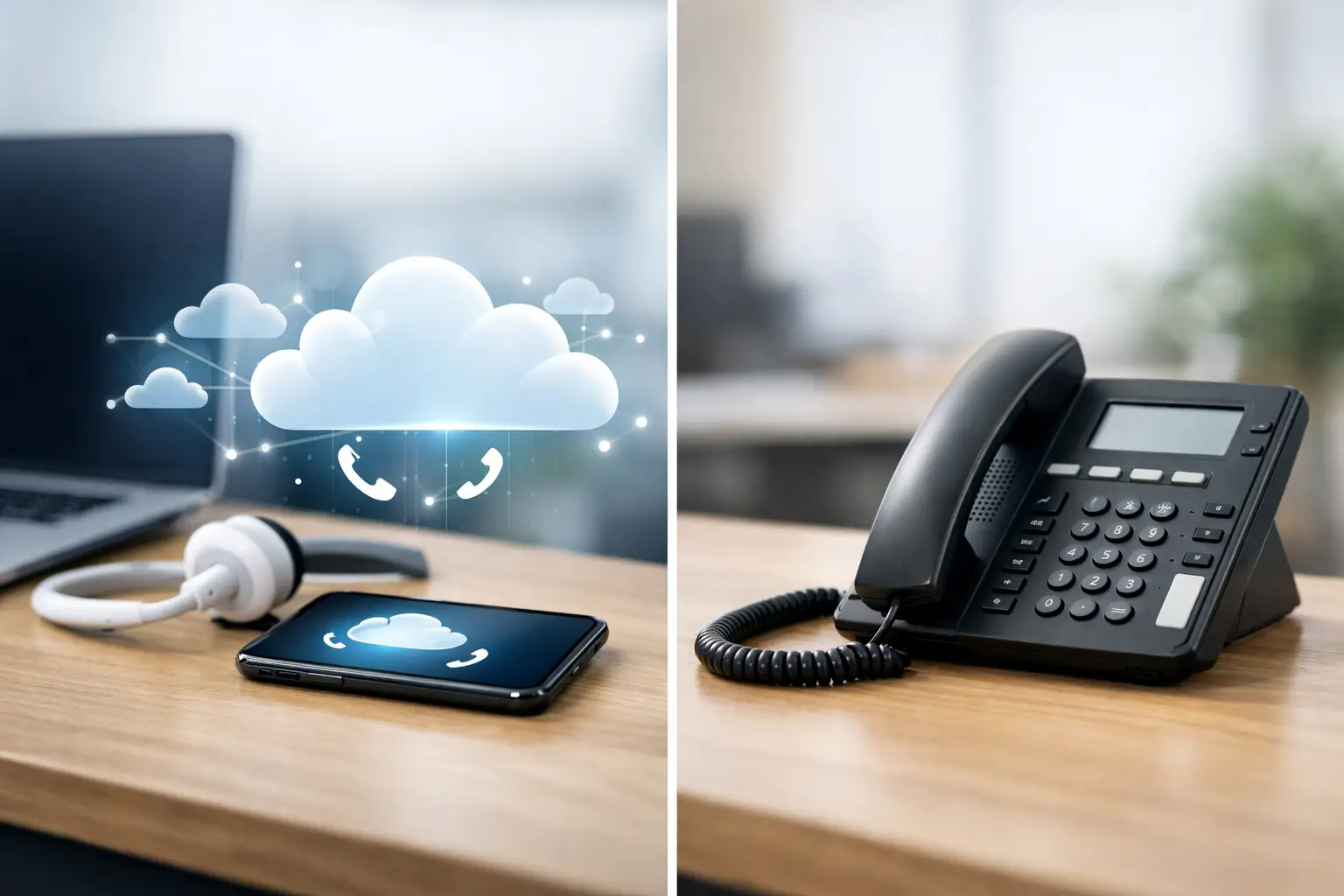
If your team is still tied to a front desk phone while customers text, call, and expect fast transfers from anywhere, your phone system is already affecting operations. That is why the cloud phones vs desk phones conversation matters for small and mid-sized businesses – not as a tech preference, but as a business decision that impacts responsiveness, cost, flexibility, and support.
Cloud phones vs desk phones: what is the real difference?
The basic difference is simple. A desk phone system usually refers to on-premise hardware connected through physical handsets, office wiring, and a PBX or similar setup. A cloud phone system moves the core phone service off-site and delivers calling through the internet, often with apps for desktop, mobile, and optional physical handsets.
That sounds straightforward, but the real gap shows up in how your business runs day to day. Desk phones are built around a location. Cloud phones are built around users, devices, and connectivity. If your staff works from one office, rarely changes, and only needs standard call handling, a traditional setup can still do the job. If your business has hybrid staff, multiple locations, field teams, or a need to scale without drama, cloud usually starts pulling ahead fast.
Where desk phones still make sense
It is easy to act like desk phones are outdated across the board. They are not. In some environments, they are still practical.
A fixed office with a stable headcount may prefer dedicated handsets on every desk. Front office staff often like the familiarity of physical buttons, line indicators, and a device that is always in the same place. Some businesses also have legacy systems that are deeply tied into door controls, paging systems, fax workflows, or older infrastructure. Replacing all of that at once may not be the right move.
There is also a comfort factor. Some teams simply work better with hardware they know. If call volume is predictable and the office rarely changes, a desk phone system can feel reliable and straightforward.
The trade-off is that the simplicity usually holds only as long as the environment stays simple. Once you add remote work, another office, after-hours routing, or staff mobility, traditional systems tend to get expensive and awkward.
Why cloud phone systems keep gaining ground
Cloud phone systems match the way many businesses operate now. Staff are not always at one desk. Salespeople work from the road. Managers take calls from home. Customer service teams need better routing, recordings, voicemail-to-email, mobile apps, and visibility into who is available.
With cloud phones, adding a new user is usually faster. Moving an employee does not require rewiring a wall jack. Routing calls to another location during an outage is easier. That matters when your business cannot afford downtime or missed calls.
For growing companies, that flexibility translates into less friction. You are not rebuilding the phone system every time your business changes. You are adjusting users, devices, and settings.
Mobility is not a perk anymore
For many businesses, mobility is now a core requirement. If your office manager is out, your receptionist is covering two roles, or your sales team lives on mobile devices, the phone system has to keep up.
Cloud platforms are designed for that. Calls can ring a desk phone, laptop app, and cell phone at the same time. Team members can transfer calls without giving out personal numbers. Supervisors can review call activity without standing next to a phone closet.
That is a major operational difference, not just a convenience feature.
Cost is more than the monthly bill
This is where a lot of businesses get tripped up in the cloud phones vs desk phones debate. They compare monthly subscription pricing to the cost of keeping an old desk phone system alive and assume the older setup is cheaper.
Sometimes it is, at least on paper. But real cost includes more than the bill.
A desk phone environment often brings hardware purchases, maintenance, service calls, limited scalability, and surprise costs when something breaks or needs reprogramming. If you have aging equipment, one failure can turn into an urgent replacement project. If your vendor support is slow, the operational cost climbs quickly.
Cloud phone systems usually shift spending toward predictable recurring costs. You may still buy handsets, headsets, or network upgrades, but the service model is often easier to budget. Updates happen without replacing a full on-site system. Expanding to a new user or office is usually less disruptive.
That does not mean cloud is automatically cheaper for every company. A very small office with minimal needs may keep costs lower with a basic traditional setup. But once flexibility, support, and growth enter the picture, cloud often delivers better value over time.
Reliability depends on your network and your support
One of the most common objections to cloud phones is reliability. Business owners hear “internet-based” and picture dropped calls, dead phones, and frustrated customers.
That concern is fair, but it needs context. A cloud phone system is only as good as the network behind it. If your office internet is unstable, your internal network is poorly configured, or your bandwidth is constantly under pressure, call quality will suffer. The fix is not avoiding cloud. The fix is building the right infrastructure.
Traditional desk phone systems are not risk-free either. If aging hardware fails, if your PBX has issues, or if your office loses local connectivity or power, you can still lose phone service. The difference is that traditional failures often require on-site intervention.
A well-designed cloud deployment with proper network setup, call routing, backup options, and responsive support can be extremely dependable. That is why phone decisions should not be separated from IT planning. Your phones are part of your operating environment, not a standalone utility.
Security matters more than most buyers expect
Phone systems carry customer conversations, voicemails, internal discussions, and in some industries, regulated information. Security should not be an afterthought.
Cloud providers often offer stronger built-in controls than older on-premise setups, including admin permissions, encrypted traffic, audit visibility, and more consistent patching. But your security still depends on user access, password hygiene, endpoint management, and network protection.
Traditional systems can also be secure, but older environments are often neglected. Unsupported firmware, weak admin controls, and undocumented configurations are common problems.
If your business already thinks seriously about cybersecurity and compliance, your phone system should be part of that same conversation.
User experience can make or break adoption
A phone system can look great in a quote and still fail in real life if your team hates using it.
Desk phones often win on familiarity. Pick up the handset, press a button, transfer the call. For some front-desk and high-volume roles, that physical workflow is still the fastest option.
Cloud systems win on flexibility and feature depth, but only if they are implemented well. Poor training, bloated interfaces, and messy call routing create frustration fast. The right setup should match how each role actually works. Some employees may want a physical handset. Others may work best with a headset and softphone app. Many businesses end up with a mix, which is often the smartest answer.
This is not an all-or-nothing choice. Cloud systems can still include desk phones. That is an important point many buyers miss.
How to decide what fits your business
If your team works entirely from one location, your current setup is stable, and your calling needs are basic, desk phones may still be enough for now. If your business is growing, adding locations, supporting hybrid staff, or trying to improve responsiveness without adding complexity, cloud deserves serious attention.
Start with your actual use case, not the trend. Look at how calls move through the business, who needs mobility, what downtime would cost, and how much support your internal team can realistically handle. Then look at the network, security, and vendor responsiveness behind the phone system.
For many small and mid-sized businesses, the right answer is not choosing old versus new. It is choosing a system that supports the way the business actually operates today and where it is headed next.
That is why a lot of organizations benefit from working with one accountable partner that can evaluate phones, network readiness, security, and support together instead of treating each piece like a separate project. When those pieces are aligned, the phone system stops being a recurring problem and starts doing its job.
The best phone system is the one your team can trust on a busy Monday morning, during a staff change, and in the middle of an outage. Pick the setup that keeps calls moving and your business easier to run.