

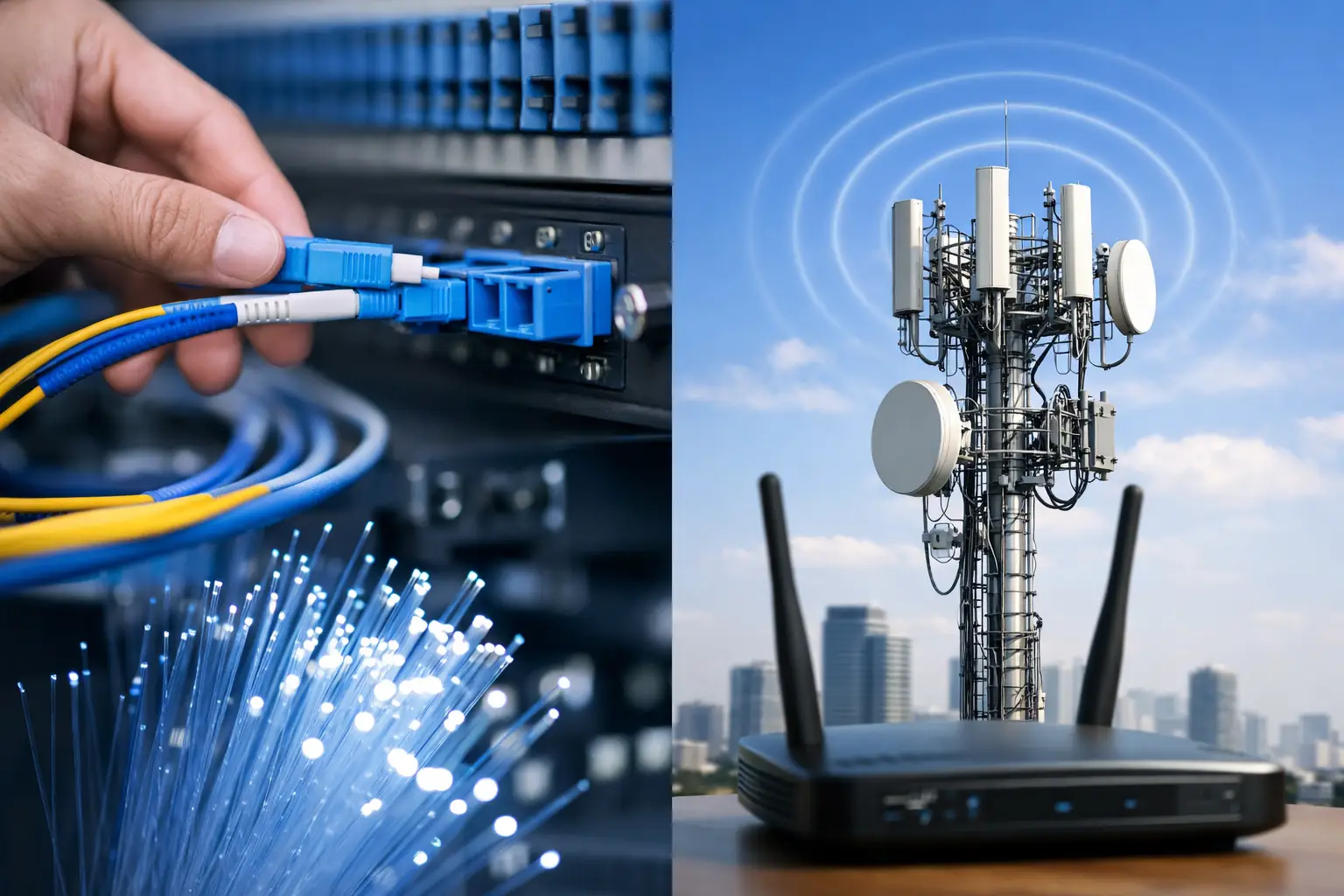
A slow network usually does not announce itself with one dramatic failure. It shows up as lag on VoIP calls, video meetings that stutter, files that take too long to open, and staff blaming “the internet” when the real problem is inside the building. That is why the fiber cabling vs wireless networks decision matters more than most businesses realize. It affects productivity, security, growth, and how often your team stops working to troubleshoot basic connectivity.
For small and mid-sized businesses, this is rarely an either-or argument. The right answer depends on how your office operates, what applications you rely on, how many devices are connected, and how much downtime your team can tolerate. If you are trying to build a network that supports real business use – not just casual browsing – the details matter.
Fiber cabling vs wireless networks: what changes in real use
Fiber cabling and wireless networks solve different problems. Fiber gives you a physical backbone built for speed, consistency, and low latency. Wireless gives users mobility, convenience, and faster deployment in spaces where cables are impractical.
The gap between them becomes obvious when your team is doing actual work. If employees are moving large files, using cloud apps all day, running IP phones, streaming security cameras, or relying on stable connections for line-of-business systems, cabling carries that load with fewer surprises. Wireless can support many of those tasks too, but performance depends on signal strength, interference, access point placement, and how many devices are competing for airtime.
That does not make wireless the weaker option across the board. In many offices, it is essential. Laptops, tablets, mobile scanners, guest devices, and flexible workspaces all benefit from wireless access. The problem starts when businesses expect Wi-Fi to do the entire job of structured infrastructure.
Speed is only part of the story
Business owners often start with speed because it is easy to measure. Fiber cabling delivers higher throughput and more consistent performance than wireless in most business environments. A wired fiber backbone can support demanding traffic loads with less variation, especially across departments sharing data-heavy applications.
Wireless speeds can look impressive on paper, but advertised maximums rarely match daily performance. Walls, metal shelving, neighboring networks, older client devices, and poor access point design all reduce actual results. In a busy office, one strong speed test in the conference room does not mean the network is healthy.
Latency matters just as much. Voice systems, video conferencing, remote desktops, and cloud-based platforms all perform better when latency stays low and predictable. Fiber handles that better because it is not fighting radio interference or waiting for multiple devices to take turns transmitting.
If your business depends on uptime and quick application response, consistency usually matters more than headline speed.
Reliability is where wired infrastructure earns its keep
Most companies do not call IT because a network benchmark dropped by 12 percent. They call when users cannot work. Reliability is where fiber cabling clearly separates itself.
A properly installed cabling system gives you a stable path from workstations, phones, printers, access points, servers, and security hardware back to the network core. Once installed and tested, it is predictable. That predictability reduces support tickets, cuts random disconnections, and makes troubleshooting far more straightforward.
Wireless networks are inherently less predictable because they operate in shared airspace. Signal conditions change throughout the day. A new tenant next door, a microwave in the break room, dense walls, or a poor access point channel plan can all create intermittent problems that waste time and frustrate users.
This is why many high-performance networks use cabling as the foundation and wireless as the access layer. Access points themselves work better when they are fed by strong wired backhaul. In other words, even your Wi-Fi often depends on good cabling behind the scenes.
Security and compliance are not equal
If your business handles sensitive customer data, payment information, protected records, or regulated workflows, security should carry real weight in this decision.
Fiber cabling offers a more controlled environment because access requires physical connection to the network. That does not make it automatically secure, but it narrows the exposure. You can lock down switch ports, segment traffic, and maintain tighter control over who connects and where.
Wireless adds convenience, but it also adds attack surface. Every SSID, authentication setting, access point, and endpoint creates another point that needs to be configured, monitored, and maintained correctly. Weak passwords, outdated encryption, poor guest network separation, and unmanaged devices all create risk.
For some businesses, especially those with compliance pressure, the issue is not whether Wi-Fi is allowed. It is whether the wireless environment has been designed with the same discipline as the rest of the network. Too often, it has not.
Cost depends on timeframe, not just installation
Wireless usually looks cheaper upfront. You can install access points faster than running structured cabling throughout a building, especially in a temporary office or a space where construction costs are high. For startups or fast-moving teams, that can make wireless attractive.
But short-term savings can turn into long-term friction. If users constantly fight weak coverage, if access points need to be added to compensate for poor planning, or if core business devices are relying on unstable wireless links, operating costs rise quietly. Productivity drops. Support requests increase. Expansion becomes messy.
Fiber cabling has higher installation cost, but it is a long-term asset. A well-designed cabling plant supports years of growth, equipment refreshes, and office changes. It gives you a cleaner path for adding workstations, phones, cameras, access control systems, and wireless access points without rebuilding from scratch.
That is why the smart comparison is not install cost vs install cost. It is total operational cost over the life of the office.
Fiber cabling vs wireless networks for different business types
The right mix changes by environment. A law office with fixed desks, VoIP phones, printers, and secure file access should lean heavily on wired infrastructure with business-grade Wi-Fi layered on top. A warehouse may need strong wireless for scanners and mobile devices, but still depend on cabling for cameras, workstations, and access points. A medical office may need both, with tighter segmentation and stronger controls due to compliance requirements.
Retail spaces are another good example of trade-offs. POS systems, security devices, and back-office equipment often belong on wired connections, while guest Wi-Fi and staff mobility depend on wireless. If everything runs over Wi-Fi because it feels easier, one interference issue can affect sales, operations, and customer experience at the same time.
Hybrid work also changes the equation. Businesses with hoteling desks and flexible layouts benefit from strong wireless design, but that does not remove the need for wired backbone infrastructure. It just changes where you place it.
When wireless is the right primary choice
There are cases where wireless should lead. If your team works mostly on mobile devices, if the floor plan changes often, or if your location is leased short term and major cabling work does not make financial sense, wireless may be the practical first move.
The key is to deploy it like business infrastructure, not like a consumer convenience feature. That means proper site assessment, enterprise access points, secure authentication, VLAN segmentation, coverage planning, and ongoing management. If you skip that discipline, you are not saving money. You are delaying problems.
When fiber cabling should be non-negotiable
If your business cannot afford interruptions, relies on high-bandwidth applications, uses a lot of fixed equipment, or needs tighter security controls, cabling should not be treated as optional. It should be part of the core design.
That is especially true if you are already investing in phones, cameras, access control, conference rooms, or managed IT support. Those systems perform better when the physical network has been planned correctly from the start. A fast wireless network cannot fully compensate for weak infrastructure underneath.
This is where businesses often lose time and money. They buy better internet service, replace routers, and add random hardware before asking whether the actual network layout supports the way the business works. A strong design fixes root causes instead of chasing symptoms.
The best answer is usually a hybrid network
For most small and mid-sized companies, the best answer in the fiber cabling vs wireless networks debate is a hybrid model. Use fiber and structured cabling to create a stable backbone. Then layer in well-designed wireless coverage for mobility and flexibility.
That approach gives you the strengths of both. Wired infrastructure handles critical systems and high-demand traffic. Wireless supports modern work styles without carrying the full burden alone. It is also easier to scale. As your team grows, your applications change, or your office footprint expands, a hybrid network gives you more room to adapt without constant patchwork fixes.
If you are planning a new office, upgrading an existing one, or dealing with recurring network complaints, this is not the place to guess. A business network should be designed around your operations, not built from convenience purchases and crossed fingers. The right setup is the one that keeps your team productive, your systems stable, and your growth from getting slowed down by infrastructure that should have been handled properly the first time.