

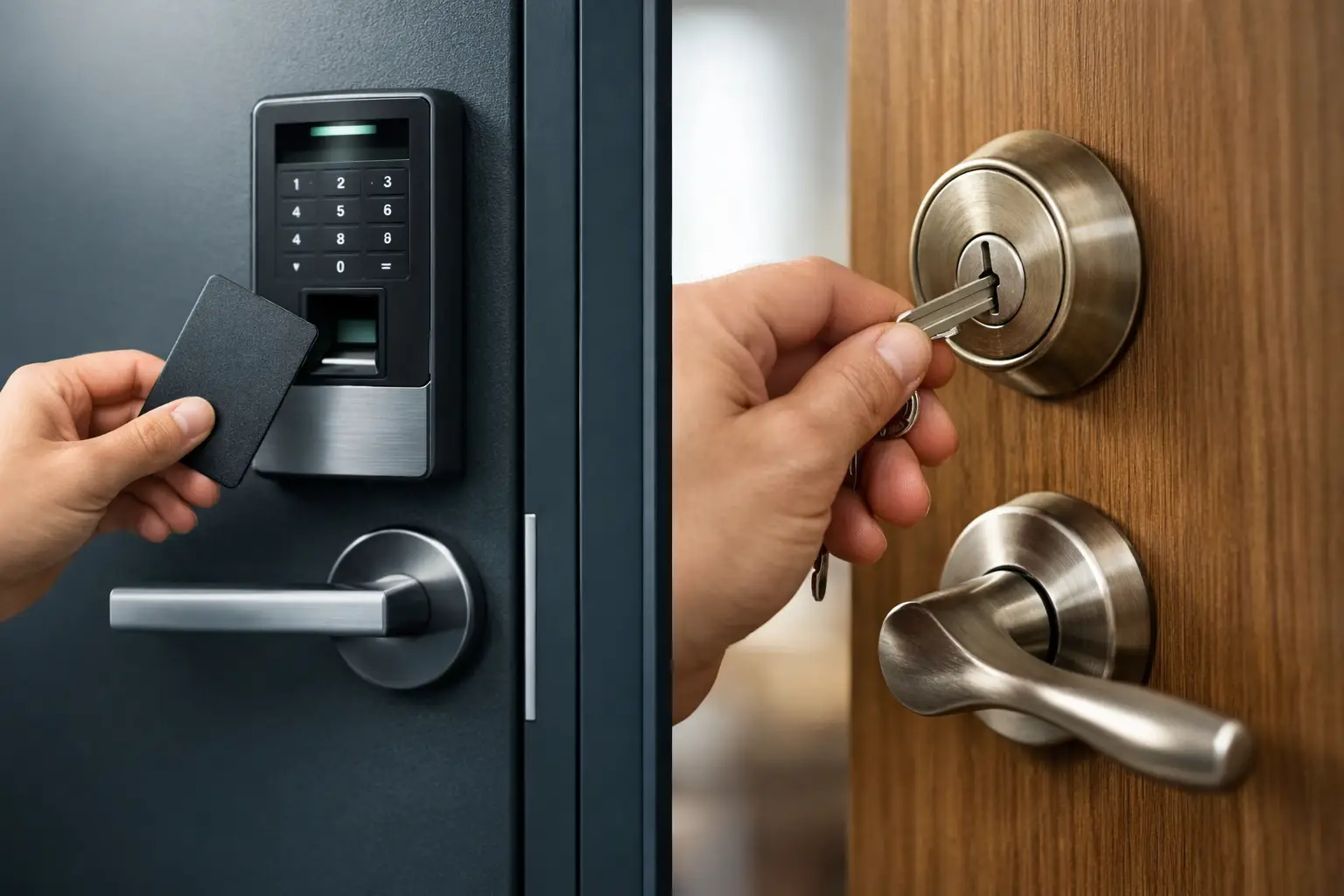
A lost office key rarely feels urgent until it becomes everyone’s problem. One employee leaves, a vendor never returns a key, or a side door gets propped open during a delivery. That is where the access control vs traditional locks decision stops being a hardware question and starts becoming an operations issue.
For small and mid-sized businesses, physical security is not just about keeping doors closed. It affects employee access, after-hours accountability, compliance, insurance conversations, and how quickly you can respond when something changes. The right setup depends on your building, your team, your risk profile, and how much control you actually need day to day.
Access control vs traditional locks: what changes in practice?
Traditional locks do one job well. They secure a door with a physical key, and they do it with relatively low upfront cost. For many small offices, storage rooms, and low-risk interior doors, that simplicity is still useful.
Access control adds a management layer on top of the lock itself. Instead of relying only on metal keys, you can grant entry with credentials such as cards, fobs, PINs, or mobile access. More importantly, you can decide who gets in, where they can go, and when that access is valid.
That distinction matters. If an employee quits on Friday, a traditional lock often forces you to choose between taking a risk or rekeying doors. With access control, you can usually remove that person’s access in minutes. That speed is not a luxury for most businesses. It is basic risk management.
Where traditional locks still make sense
It is easy to treat older lock systems as outdated, but that is not always accurate. Traditional locks are still practical in the right environment.
If you run a very small office with limited staff turnover, minimal compliance pressure, and only a few doors to secure, standard locks may be enough. They are familiar, inexpensive, and not dependent on software, network connectivity, or power planning. In a low-complexity setting, that can be a real advantage.
They also work well as part of a layered approach. Mechanical locks still have a place on private offices, storage closets, or backup entry points, even in buildings that use electronic access control at main entrances. Not every door needs the same level of technology.
The trade-off is management. Keys can be copied, shared, misplaced, or never returned. Once that happens, you lose visibility fast. You may know a key exists, but you do not know who has it today or whether it was duplicated last year.
Why more businesses are moving to access control
The biggest reason is control, but convenience runs a close second. Business owners and operations teams want fewer security blind spots and fewer manual workarounds.
Access control helps solve common problems that traditional locks handle poorly. You can assign credentials by employee, department, or schedule. You can restrict access to inventory, server rooms, accounting offices, or other sensitive spaces without issuing separate physical keys. You can also create temporary access for vendors, cleaning crews, or contractors and remove it when the job is done.
That level of flexibility matters even more if your business has multiple shifts, frequent onboarding, or shared spaces. A growing company often outgrows physical keys before it realizes it. Once key control breaks down, the business starts absorbing hidden costs in rekeying, downtime, and avoidable security risk.
Access logs are another major difference. With traditional locks, you usually know whether the door was secured, but not who entered or when. Access control systems can provide timestamps and user-level entry records. That does not replace cameras or internal policies, but it gives managers a clearer picture of what happened and when.
Cost is more than the price of the lock
This is where many businesses get stuck. Traditional locks are cheaper to install, and that matters. If you compare hardware alone, mechanical systems almost always win the upfront price conversation.
But the real comparison is total operating cost over time. If you rekey doors every time a manager leaves, if you replace lost keys regularly, or if staff spend time chasing down access issues, the cheap option gets less cheap. Add a single incident involving unauthorized entry, and the math can change quickly.
Access control usually costs more at the start because it includes readers, credentials, controllers, power, possible cabling, and system setup. Depending on the environment, there may also be software licensing or cloud management costs. For some businesses, that upfront investment is worth it immediately. For others, it only makes sense at specific doors where risk or traffic is higher.
A good rule is to avoid all-or-nothing thinking. You do not need to convert every lock in the building at once. Many businesses start with primary entry doors, sensitive rooms, and areas where employee turnover or third-party access is common. That targeted approach often delivers the best return first.
Security, convenience, and accountability
If your only goal is to keep a basic door shut, traditional locks can do the job. If your goal is to manage access actively, access control is in a different category.
Security is not just about stopping intruders. It is also about reducing internal confusion. Who has access to payroll records? Who can enter the warehouse after hours? Can a former employee still get in with an old key? Can your office manager disable access without waiting for a locksmith?
Access control answers those questions faster and with more precision. It also supports cleaner offboarding, which is one of the most overlooked security gaps in smaller companies. Businesses often do a decent job shutting off email and software accounts, but physical access gets missed. That is a costly oversight.
Convenience matters too. Employees do not want to carry a ring of keys for every door. Managers do not want to track who borrowed the conference room key or call around because a supervisor is absent. Better access management reduces friction, and less friction usually means better compliance with the process.
Access control vs traditional locks for growing businesses
Growth changes the equation. A single office with six employees has very different needs than a company with multiple suites, a warehouse, rotating staff, and outside vendors.
As businesses grow, they usually need faster onboarding, cleaner offboarding, and better visibility across locations. Traditional locks tend to become harder to manage as headcount rises. The more people and doors involved, the less practical it becomes to depend on key copies and manual recordkeeping.
Access control scales better because permissions can be managed centrally. That is especially useful for organizations juggling operations, customer service, inventory, and IT assets in the same facility. If your team already depends on digital systems for everything else, managing door access manually starts to feel like an obvious gap.
This is also where integration becomes valuable. In some environments, access control can work alongside surveillance, alarms, visitor management, and broader security policies. That creates a more coordinated setup instead of a collection of disconnected tools.
When a hybrid approach is the smart move
For many companies, the right answer is not access control or traditional locks. It is both.
A hybrid setup gives you stronger control where it matters most without overspending on every opening in the building. Main entrances, IT rooms, executive areas, records storage, and high-value inventory spaces are good candidates for electronic access control. Lower-risk doors can often remain mechanical.
That approach keeps the project practical. It also gives businesses room to phase upgrades over time instead of forcing a large capital expense all at once. A service partner with infrastructure and security experience can help map which doors need higher control and which do not.
For businesses in active growth mode, that planning is often more valuable than the hardware itself. The goal is not to install technology for the sake of it. The goal is to reduce risk, simplify management, and make the building easier to run.
How to choose the right fit
Start with the questions that affect your day-to-day reality. How often do employees come and go? Do vendors or contractors need temporary access? Are there rooms with sensitive data, expensive equipment, or regulated information? How much disruption would a lost key cause? How quickly do you need to revoke access when something changes?
If those questions point to complexity, access control is usually the stronger long-term investment. If your environment is simple and stable, traditional locks may still be enough in some areas.
The best decisions come from looking at the full operating picture, not just the lock on the door. Security should support the way your business actually runs. If your access setup creates delays, confusion, or risk every time staffing changes, it is already costing you more than it should.
The right system is the one that gives you control without creating extra work, and that usually starts by treating door security like business infrastructure instead of an afterthought.